Executive Summary – For Readers Short on Time
- Salesforce is not just the world’s leading CRM company. It is the most productive intellectual engine in the history of enterprise software – producing books, frameworks, and executives that have reshaped entire markets.
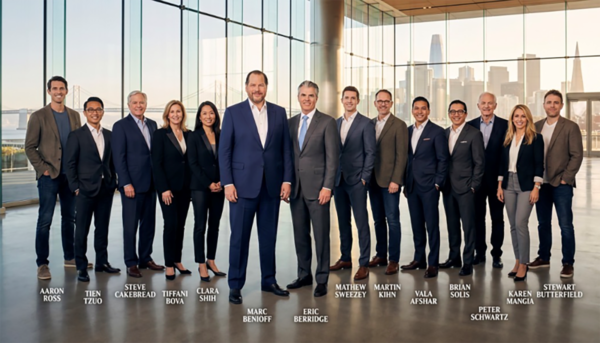
- Twelve alumni authors explain the company’s success better than any corporate history – from Benioff’s category story and Ross’s revenue machine, to Berridge’s customer obsession operating system, Tzuo’s subscription model, and Kihn’s data-and-AI architecture.
- Stewart Butterfield’s Slack philosophy – communication as fundamental business capability – is the newest chapter in the canon.
- The alumni who left built companies worth billions.
- The lesson that didn’t fully stick: The stakeholder capitalism argument of Benioff’s Trailblazer faces its hardest test as AI-driven layoffs challenge Salesforce’s stated values.
$150B: Salesforce market cap today – built up from its “rented apartment” status in 1999
$10B: Valuation of Sierra AI, founded by former co-CEO Bret Taylor, just two years after leaving Salesforce
$3B: Market cap of Calix, led by Salesforce alum Michael Weening – proof the “school” keeps producing
In over 40 years of interviewing sales leaders, CEOs, and business builders, I have come to believe that the most revealing thing about a great company is not what it sells but what it produces. Not just revenue and market share, but ideas, people, and frameworks that outlast the quarterly report and reshape entire industries.
By that measure, Salesforce – today a $150 billion company started in a rented San Francisco apartment in 1999 – may be the most productive intellectual engine in the history of enterprise software. I have watched this company evolve since Marc Benioff was still explaining to skeptical IT buyers that software over the internet was liberation, not a security risk. What has always struck me is not the product but the culture of conviction: Salesforce trained people to believe that trust, not technology, was the ultimate competitive advantage. When those people left, they carried that conviction into companies of their own.
The books its alumni wrote are the most complete explanation of why Salesforce won that you will find anywhere outside the company itself. This essay walks through the canon – and then turns to the leaders who left to build what they learned.
Special Opportunity: Tiffany Bova and Aaron Ross will join us as keynote speakers at our virtual Revenue Acceleration Summit June 24-25th. To sign up free, click on this link: https://bit.ly/4rRTgnR
– ◆ –
Part One: The Books
THE CATEGORY STORY
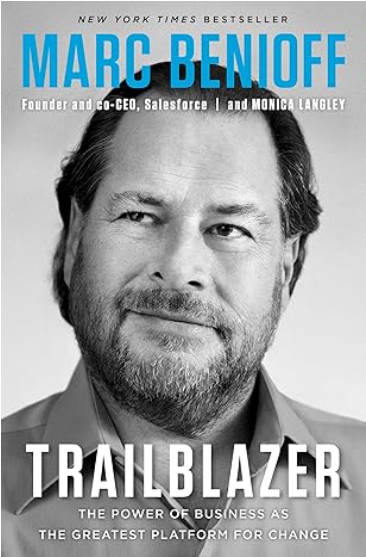
Marc Benioff – Behind the Cloud (2009) and Trailblazer (2019)
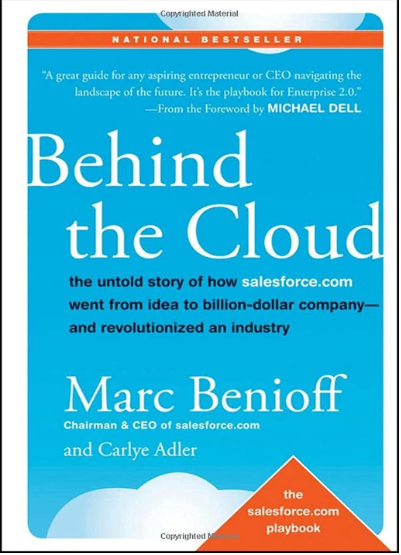
“I started salesforce.com in a rented apartment in 1999 with the goal of making enterprise software as easy to use as a Web site like Amazon.com.”
– BEHIND THE CLOUD“Doing well by doing good is no longer just a competitive advantage. It’s becoming a business imperative.”
– TRAILBLAZER
Everything begins with Benioff. In Behind the Cloud, he tells the story of a startup built around one audacious claim: that enterprise software should feel as effortless as buying a book on Amazon. That may sound modest today, but, in 1999, telling IT buyers that their CRM should live on the internet was a category fight, not a feature comparison – and Salesforce won it before most incumbents understood what was happening.
From the floor of the NYSE: Marc Benioff gave me one of the most memorable moments of my 40 years covering the sales industry. When Salesforce went public in June 2004, he invited me to the New York Stock Exchange to ring the opening bell – as the only member of the press in the room. I still have the silver commemorative medallion he gave me that day. Holding it, I remember thinking: This is not a software company going public. This is a conviction going public. I have since done a cover story with Marc for Selling Power, and I have interviewed him many times on Selling Power TV. The thread that runs through every conversation is unchanged from that morning on the trading floor: Marc thinks in categories, not products, and in movements, not markets. His most recent declaration on agentic AI captures that instinct perfectly. “The agent revolution is real and as exciting as the cloud revolution,” he told me. “It will provide a level of transformation that we’ve never seen.” At Dreamforce 2025, he framed it even more boldly: “We’re entering the age of the agentic enterprise – where AI elevates human potential like never before.”
THE REVENUE MACHINE
Aaron Ross and Marylou Tyler – Predictable Revenue (2011)
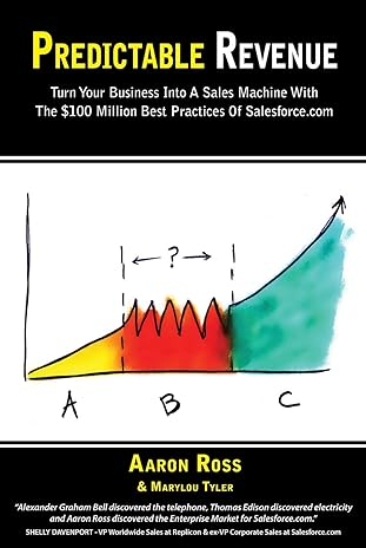
“In order to create more predictable revenue you must build a better sales machine.”
– PREDICTABLE REVENUE
A great story without a great sales machine is just a pitch. Aaron Ross gave Salesforce the machine. As an internal entrepreneur at Salesforce, Ross built an outbound prospecting function that helped generate over $100 million in incremental recurring revenue. His insight – deceptively simple in hindsight – was that revenue becomes predictable only when you separate the functions that generate it. Prospecting, qualification, closing, customer success, and attribution should each be handled by specialists. The heroic generalist closer is a bottleneck, not a system.
From my conversations with Aaron: Ross once told me that when he first proposed the specialized SDR model internally, the instinct from sales management was to resist it – they wanted closers, not “just” prospectors. What changed minds was the data. “Marc always wanted proof,” Aaron told me. “Once the numbers showed what the outbound team was generating in truly incremental revenue, the conversation was over.” That demand for measurable operating rigor – not just inspired storytelling – was Benioff’s discipline at work.
THE SUBSCRIPTION MODEL
Tien Tzuo and Gabe Weisert – Subscribed (2018)
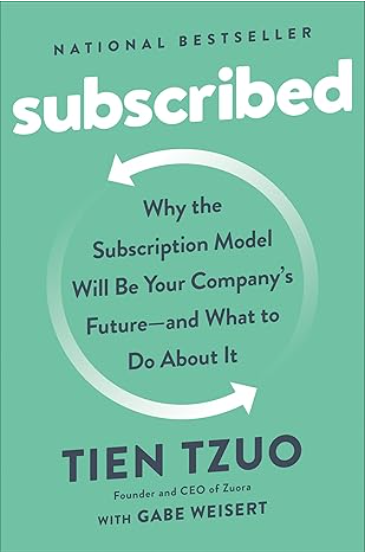
“Subscriptions are the only business model that is entirely based on the happiness of your customers. Think about it – when your customers are happy, then they’re using more of your service, and telling their friends, and you’re growing.”
– SUBSCRIBED
Tien Tzuo joined Salesforce as employee number 11, built its original billing system, and eventually served as chief marketing officer and chief strategy officer. When he left to found Zuora in 2007, he carried the deepest possible understanding of what made the subscription model revolutionary: not the pricing structure, but the relationship architecture underneath it. Subscription companies must earn renewal continuously – every month is a new vote of confidence. That accountability, built into the commercial model itself, made Salesforce a fundamentally different kind of enterprise software company. Benioff’s endorsement of the book called it “the definitive playbook for anyone navigating the most important business model shift of our time.”
PUBLIC-MARKET DISCIPLINE
Steve Cakebread – The IPO Playbook (2020)
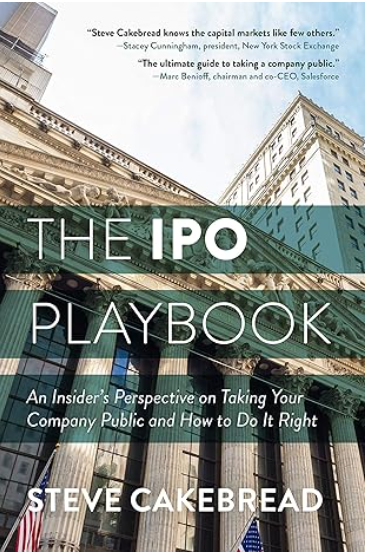
“Most founders want to create opportunity both for themselves and for the people around them, and this happens only when you go public.”
– THE IPO PLAYBOOK
Steve Cakebread, the CFO who took Salesforce public in 2004, provided the financial architecture that gave the company enterprise credibility. His core argument: Going public is not merely a financing event – it is a discipline event. For Salesforce, the 2004 IPO made the subscription economics visible to buyers still skeptical of cloud delivery. A company willing to publish its financials to the world was demonstrating trust in the most concrete possible way – and passing that test repeatedly became a competitive advantage in itself.
GROWTH SEQUENCING
Tiffani Bova – Growth IQ (2018) and The Experience Mindset (2023)
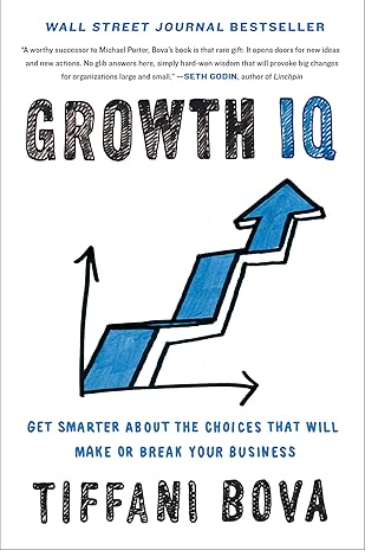
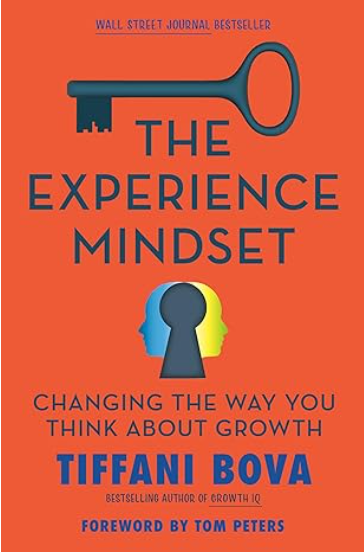
“The underlying concept of Growth IQ has everything to do with the combination and sequence with which companies actually pursue and deploy the growth paths.”
– GROWTH IQ
Tiffani Bova’s central argument in Growth IQ is that there is no silver bullet for growth – only the right combination of paths, executed in the right sequence. Salesforce pursued category creation, direct sales, ecosystem building, product expansion, platform, and trust in sequence, not simultaneously. The Experience Mindset sharpened a related insight: You cannot sustain superior customer experience without superior employee experience. Culture is not a soft asset. It is a delivery mechanism – and Salesforce’s Trailblazer community was proof.
THE CUSTOMER OBSESSION IMPERATIVE
Eric Berridge – Customer Obsessed (2016)
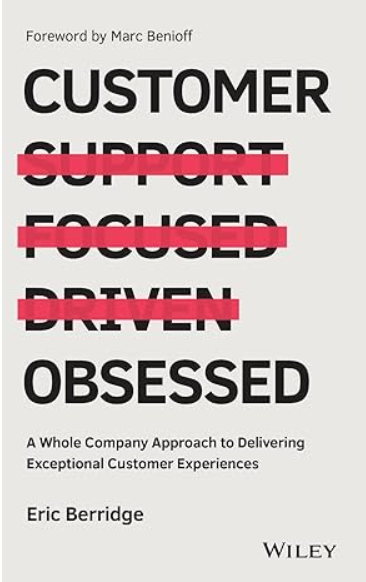
“More important than the technology is building a company culture that focuses on the well-being of all stakeholders – not just shareholders, but also employees, customers, our communities, and even the environment – to achieve the highest levels of success.”
– CUSTOMER OBSSESSED
Eric Berridge’s career is itself a Salesforce canon in miniature. He co-founded Bluewolf in 2000 – the original and preeminent Salesforce consulting firm – sold it to IBM in 2016, led Professional Services inside Salesforce as chief commercial officer, then became CEO of Coastal in 2023, the number one rated Salesforce consulting partner. That role culminated in Coastal’s acquisition by Tata Consultancy Services in December 2025 – the largest professional services deal in Salesforce ecosystem history. Customer Obsessed argues that customer obsession must extend beyond front-line teams into every department: data, design, and culture all oriented through a customer-first lens.
From my Selling Power TV interview with Eric Berridge: By the time Eric and I sat down for Selling Power TV, he had already written Customer Obsessed and was leading Coastal as CEO. The conversation confirmed what the book had argued: The philosophy hadn’t changed, only the platform. He put his core belief directly: “Customers want to buy expertise – they don’t want to necessarily buy scale. If they have to pick between expertise and scale, they’ll typically lean toward expertise.” That is both Bluewolf’s origin story and Coastal’s competitive strategy. Berridge has always been an outlier – a humanist who built his firms with fewer than 10% engineering graduates, believing empathy and storytelling would prove more durable differentiators than technical credentials. In a world where AI is commoditizing the technical layer, that bet looks better every day.
THE SOCIAL & CONTEXTUAL CUSTOMER
Clara Shih – The Facebook Era (2009) and The Social Business Imperative (2016)
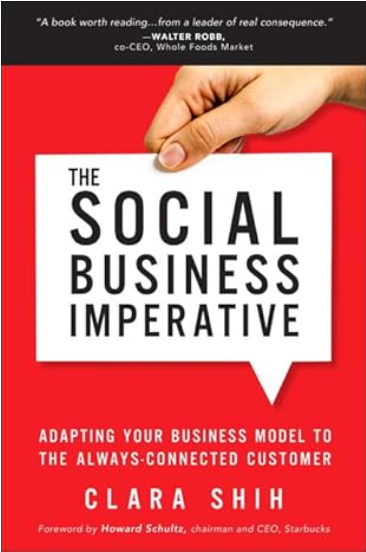
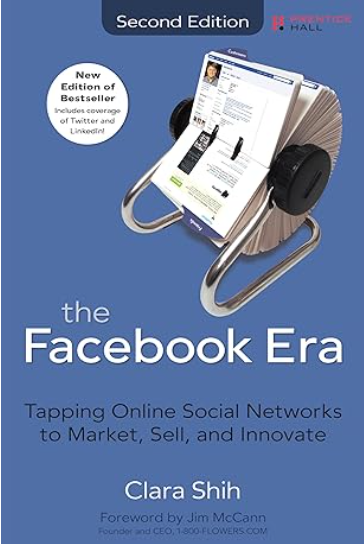
“The combination of social media expansion and increasingly powerful data analysis capabilities is creating unmatched opportunities to fundamentally reorganize our businesses.”
– THE SOCIAL BUSINESS IMPERATIVEFrom my Selling Power interview with Clara Shih: I interviewed Clara for Selling Power and on Selling Power TV in 2010, when social CRM was still a radical idea. She told me something that has stayed with me ever since: “Facebook is like CRM for individuals – it’s how an increasing number of people manage contacts across their personal and professional lives.” What she was really saying was the customer data that companies needed had already been assembled – by the customers themselves, voluntarily, on social networks. Salesforce’s job was simply to connect those two worlds. A decade and a half later, as CEO of Salesforce AI and now VP of Business AI at Meta, she is still connecting those worlds – only now the connective tissue is artificial intelligence rather than a Facebook integration. Her career arc from social CRM pioneer to enterprise AI executive is, in miniature, the story of the entire Salesforce canon.
Her later work extended the argument: Social doesn’t change the marketing channel; it changes the operating model. Mathew Sweezey, writing from inside the Pardot team, added the crucial dimension of context. In an age of infinite media, the question is not how loudly you can broadcast but how precisely you can match your message to the customer’s moment. Together, Shih and Sweezey articulated the customer reality that Salesforce’s Customer 360 strategy was built to address: not a database project, but a context engine designed to make the right engagement possible at the right moment across every channel.
Mathew Sweezey – The Context Marketing Revolution (2020)
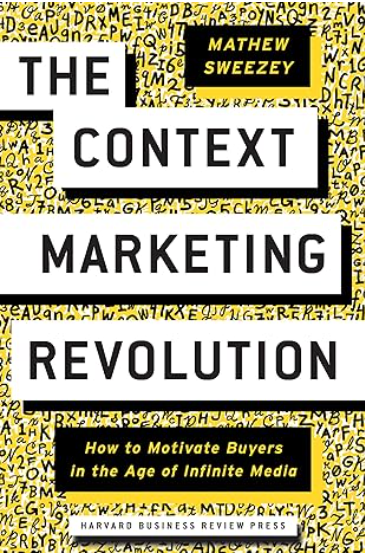
“In a transformed world where customers shape their own experience, what is the key to breaking through and motivating them to buy? It is context.”
– THE CONTEXT MARKETING REVOLUTION
THE DATA & AI LAYER
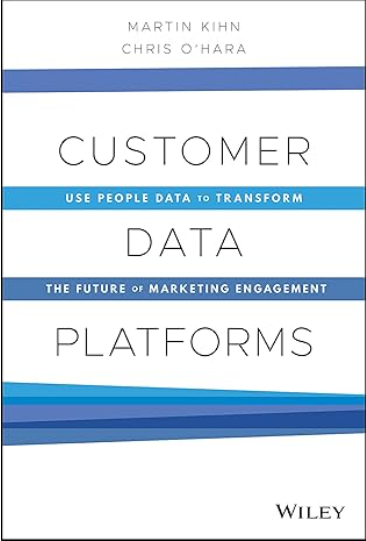
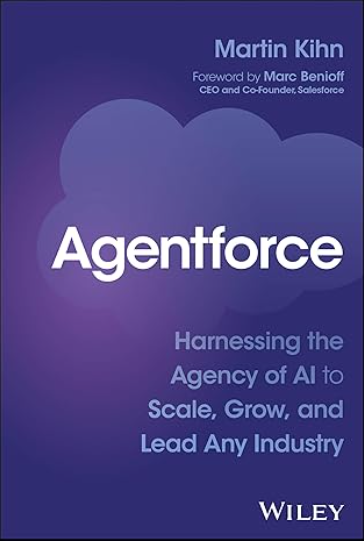
Martin Kihn – Customer Data Platforms (2020), Customer 360 (2024), and Agentforce (2025)
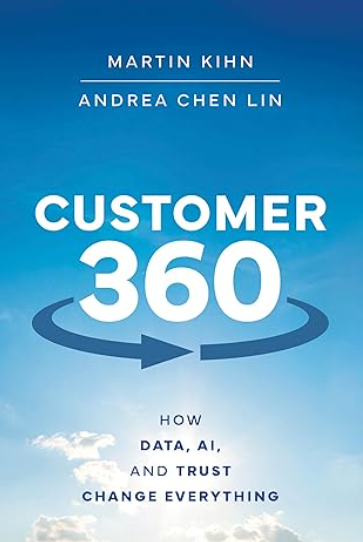
“Become more competitive by developing a superior customer experience through data, AI, and trust.”
– CUSTOMER 360
Martin Kihn has chronicled, in real time, the evolution of Salesforce’s most important strategic bet: the move from CRM application to data platform to AI-powered agent infrastructure. Customer Data Platforms explained why unified customer data is a strategic imperative. Customer 360 extended that into a trust architecture. And Agentforce chronicles the next leap: AI agents become enterprise labor only when they can be governed, measured, and connected to trusted workflows. The companies best positioned for the agentic era are not necessarily those with the most sophisticated models – they are the ones with the best customer data and the deepest trust relationships. Salesforce built both over 25 years.
EVANGELIST ENERGY
Vala Afshar – Boundless (2023) and Autonomous (2025)
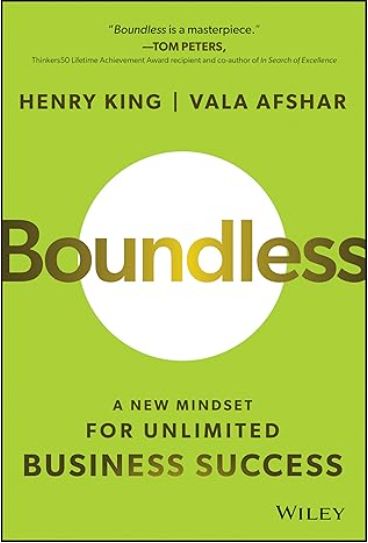
“They outline seven core principles to break down organizational silos: connection, integration, decentralization, mobility, continuity, autonomy, and scale.”
– BOUNDLESS
Brian Solis – WTF?: What’s the Future of Business? (2013) and five other books
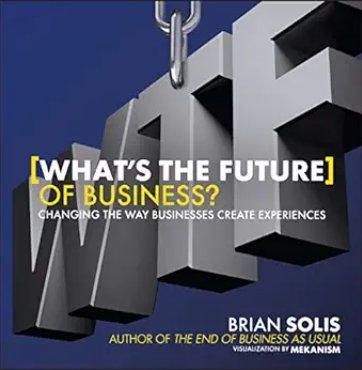
“Connect the digital and human experience to build confidence and trust, for both your employees and customers.”
– BRIAN SOLIS
What Benioff understood – and what very few technology CEOs have replicated – is that market education is a form of go-to-market. Vala Afshar and Brian Solis were not decorative evangelists. They were strategic assets who converted broad market transitions into customer transformation narratives that made Salesforce’s product agenda feel inevitable. Afshar mapped the arc from social business to the boundless, AI-first enterprise. Solis, Salesforce’s global innovation evangelist, added six books on the connected customer, the experience economy, and the leadership mindset required to navigate permanent disruption. Their books are artifacts of a culture that institutionalized thought leadership as part of go-to-market – and, for sales leaders, the lesson is profound: The best organizations don’t just close deals; they create believers.
SCENARIO PLANNING
Peter Schwartz – The Art of the Long View (1991/1996)
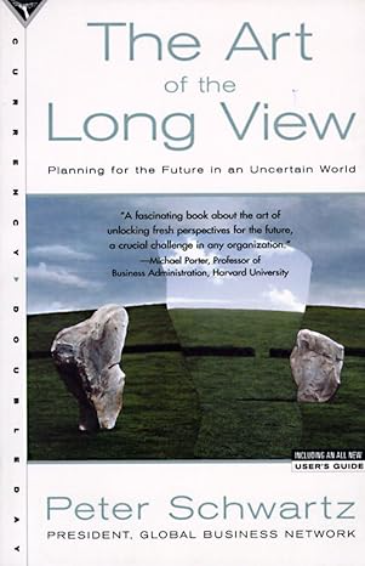
“The ability to act on what you know, even when it contradicts conventional wisdom, requires a kind of inner security that only comes from having thought through the future carefully.”
– THE ART OF THE LONG VIEW
Most companies forecast. Salesforce, under Peter Schwartz as chief futures officer, practiced scenario planning: considering multiple plausible futures rather than betting on a single prediction. Benioff’s decision to give a futurist a senior operating role says everything: We are serious about thinking ahead, not just executing against last quarter’s plan. Salesforce’s willingness to make large bets before market consensus formed – on SaaS, ecosystems, social, data, and AI – reflects a company that genuinely institutionalized foresight.
THE FUTURE-OF-WORK LENS
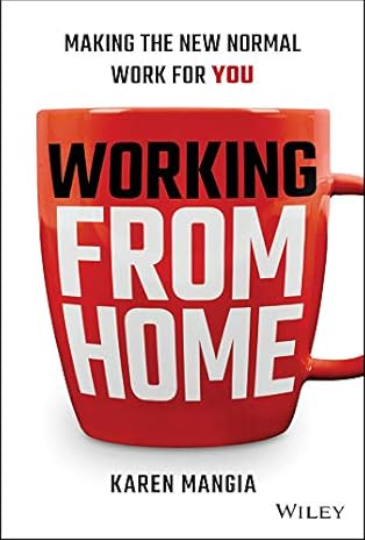
Karen Mangia – Working from Home (2020) and Success from Anywhere (2021)
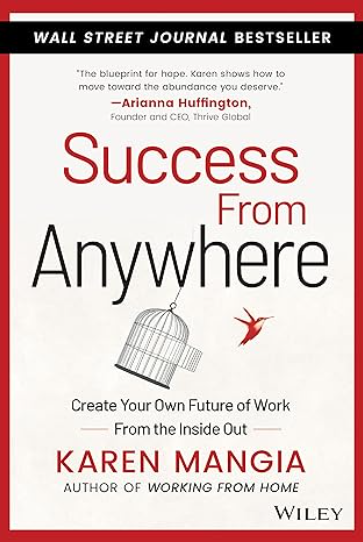
“They want their employer to say, ‘I trust you to do your best work and to decide where and when work needs to happen.’”
– SUCCESS FROM ANYWHERE
When the pandemic forced the question of where and how work happens, Salesforce did not simply implement a remote-work policy. It narrated the future of work publicly – and Karen Mangia gave that narration its most practical expression. Her core insight resonates deeply with what I have observed in high-performing sales organizations: Trust has replaced visibility as the foundation of effective management. That shift connects directly to Salesforce’s acquisition of Slack as a platform for distributed selling and collaboration – a connection that brings us to the newest chapter in this canon.
THE 2026 CHAPTER – COMMUNICATION AS STRATEGY
Stewart Butterfield and the Slack Philosophy
“What percentage of the intelligence, creativity, talent, and experience of all the employees is actually being effectively applied towards the accomplishment of goals?”
– STEWART BUTTERFIELD, CEO AND CO-FOUNDER, SLACK
Salesforce’s $27.7 billion acquisition of Slack in 2021 added a new intellectual tradition to the canon – one built by Stewart Butterfield, a Cambridge-trained philosopher who believed that communication is a fundamental business capability. “Studying philosophy taught me two things,” Butterfield has said. “I learned how to write really clearly. I learned how to follow an argument all the way down, which is invaluable in running meetings.” That clarity-first instinct is written into Slack’s DNA: transparency, information access, and the democratization of voice are not nice-to-have features but competitive infrastructure. As Salesforce pushes Agentforce into the era of digital labor, Slack’s role as connective tissue between human workers and AI agents makes Butterfield’s question the most urgent one in enterprise software right now: What percentage of your employees’ intelligence and creativity is actually being applied toward your goals?
The Lesson That Hasn’t Fully Stuck
The Stakeholder Capitalism Contradiction
No honest reading of the canon is complete without acknowledging the tension at its center. Trailblazer’s argument – that business can simultaneously maximize profit and serve employees, customers, communities, and society – is the most ambitious claim in the collection. Peter Goodman’s Davos Man names Benioff as a central example of the “stakeholder capitalist” whose philanthropy coexists with systems that concentrate wealth. Anand Giridharadas’s Winners Take All makes the structural argument: Elites who seek to do more good but never less harm often reinforce the status quo. From the right, Stephen Soukup’s The Dictatorship of Woke Capital argues the mirror-image critique.
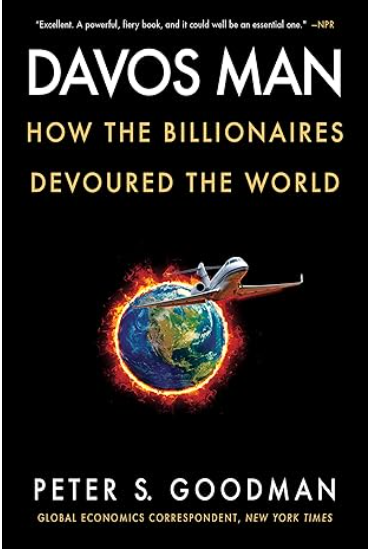
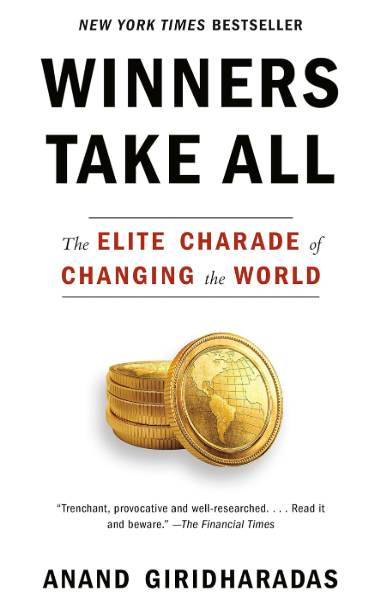
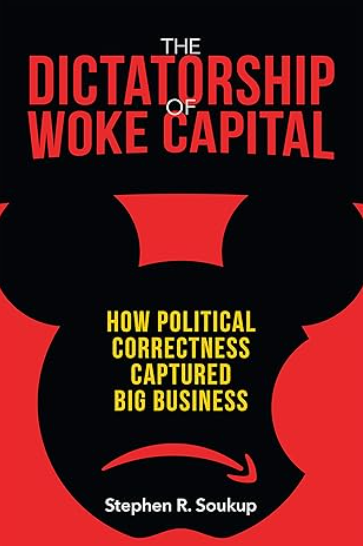
The test came in 2025. When Salesforce deployed Agentforce and eliminated thousands of customer service roles – the very roles its “Ohana” culture had celebrated – it forced the question every reader should carry back to Trailblazer: when values collide with AI economics, who decides what “doing good” means? That tension, honestly acknowledged, makes the canon more interesting – not less.
Part Two: The Alumni – A School for Business Builders
The numbers make the argument:
- Salesforce itself: $150 billion market cap built up from its beginnings in a rented apartment in 1999.
- Alumni companies: over $8.8 billion in total funding raised.
- Bret Taylor’s Sierra AI: $10 billion valuation less than two years after leaving.
- Michael Weening’s Calix: $3 billion market cap.
These are not coincidences – they are the returns on a shared intellectual investment, the operating DNA Salesforce embedded in a generation and sent into the world.
Tien Tzuo
Founder and CEO, Zuora
- Salesforce role: Employee number 11; built original billing system; CMO; chief strategy officer (1999-2007)
- What they built: Zuora, the leading subscription management platform, which evangelized the “Subscription Economy” as a category
- Scale: Went public 2018; taken private by Silver Lake for $1.7B in 2025
Bret Taylor
Co-founder and CEO, Sierra AI – Valued at $10B
- Salesforce role: President and COO; co-CEO (2021-2023)
- What they built: Sierra – enterprise conversational AI that crossed $100M ARR seven quarters after launch; raised $350M at $10B valuation in 2025. Former chairman, OpenAI board.
Howie Liu
Co-founder and CEO, Airtable
- Salesforce role: Product leader (Salesforce acquired his startup Etacts in 2011)
- What they built: Airtable – no-code collaboration used by 500,000+ organizations, 80% of Fortune 500; $1.4B raised, ~$478M ARR, cash flow positive
Michael Weening
President and CEO, Calix – Market Cap: $3B
- Salesforce role: SVP Customer Success (Global); SVP Japan and Asia-Pacific (2012-2016)
- What they built: Led Calix from hardware to cloud/software platform; applied Salesforce’s customer-success-first discipline to broadband
Aaron Ross
Co-founder, Predictable Revenue Inc.
- Salesforce role: Built the outbound SDR model generating $100M+ in incremental ARR
- What they built: The most-cited book in modern B2B sales and a global consulting practice; standard curriculum from Series A to Fortune 500
Clara Shih
VP Business AI, Meta
- Salesforce role: Product and marketing executive; CEO, Salesforce AI
- What they built: Led Salesforce AI, then moved to Meta – her arc from social CRM pioneer to enterprise AI executive is the story of the Salesforce canon in miniature
Steve Cakebread
Serial Public-Market CFO and Author
- Salesforce role: CFO (took Salesforce public in 2004)
- What they built: A repeatable IPO framework applied at Pandora, Yext, and others; the 2004 Salesforce IPO gave cloud software its first enterprise credibility signal
Masha Sedova
Co-founder, Elevate Security
- Salesforce role: Senior director of Trust Engagement
- What they built: Carried Salesforce’s “trust” operating principle into cybersecurity – a company focused on human risk management
Eric Berridge
CEO, Coastal (acquired by TCS, Dec. 2025)
- Salesforce role: Co-founded Bluewolf (2000); sold to IBM (2016); EVP/CCO Salesforce; CEO Coastal (2023)
- What they built: Coastal became the number one rated Salesforce consulting partner; acquired by TCS in December 2025 – the largest professional services deal in Salesforce ecosystem history
This list is representative, not exhaustive. The Salesforce alumni network spans thousands of founders, executives, investors, and operators across every sector of the technology economy, with total company funding raised of over $8.8 billion – and counting.
What the Canon Tells Us
Four patterns emerge when you read these books as a system.
- Salesforce won by turning product innovation into category narrative. “No Software” was not a feature claim – it was a category fight won before most incumbents understood what was happening. You weren’t buying CRM. You were joining a movement.
- It won by making revenue repeatable. Ross’s sales machine – the specialization of roles, the measurement of every pipeline stage – gave the company a disciplined engine underneath the inspiring story, one that scaled from startup to $40 billion in annual revenue.
- It won by making customer success a company-wide language: not a department, but a promise kept across every function, every product, every partner. Subscription economics made that promise structural – in a world where every contract renews annually, earning renewal is survival.
“The most valuable thing Salesforce produced was not its software. It was a generation of business builders who understood that trust, not technology, is the ultimate competitive advantage.”
- Most durably, Salesforce won by building a belief system around trust. Trust in cloud delivery, in data use, in AI governance, between employer and employee, between company and society.
- Butterfield’s communication philosophy, woven into Salesforce through Slack, adds a fifth dimension: Organizations can only act on what they know when information flows freely and every voice has a channel.
But the canon also contains a warning: The “stakeholder capitalism” argument of Benioff’s Trailblazer faces its hardest test as AI economics collide with Salesforce’s “Ohana” culture. The critics deserve a seat at the table of any honest reading.
I began my career with the conviction that selling is fundamentally about trust – that the salesperson who earns it consistently will always outperform the one who simply closes harder. What the Salesforce alumni books show, at a scale I could not have imagined when I started Selling Power, is that the same principle scales from individual seller to $150 billion enterprise. That is why Salesforce won. And that is why the companies its alumni are now building – from Sierra’s conversational AI to Coastal’s customer-obsessed consulting model – are the next chapters in the same story.
Special Opportunity: Tiffany Bova and Aaron Ross will join us as keynote speakers at our virtual Revenue Acceleration Summit June 24-25th. To sign up free, click on this link: https://bit.ly/4rRTgnR

Gerhard Gschwandtner is the founder and CEO of Selling Power and the producer of the Revenue Acceleration Summit (June 24-25, 2026). He has interviewed Marc Benioff and hundreds of the world’s top sales leaders and authors over a career spanning more than four decades. Reach him at gg@sellingpower.com.
Get our Enewsletter
Get the latest sales leadership insight, strategies, and best practices delivered weekly to your inbox.
Sign up NOW →