How Mural turns scattered conversations into collective intelligence — and collective intelligence into closed deals.
I have interviewed hundreds of sales leaders. Most talk about tools. Bill Dwoinen, CRO of Mural, talks about something rarer: language.
Not literal language. The language of context. The story a customer tells your rep in March that gets lost by June, retold badly in September, and forgotten entirely by the time the account changes hands. Every company has this problem. Few name it as clearly as Bill did when we spoke.
Bill’s path runs through CareerBuilder, LinkedIn, Slack, and Salesforce — a résumé that reads like a masterclass in how sales cultures evolve. CareerBuilder taught him to grind. LinkedIn taught him rigor with humanity attached. Slack and Salesforce taught him execution at a level he had never seen. He is part of a growing fraternity: the Salesforce alumni who now run revenue organizations across the industry, carrying forward a discipline that outlasted their tenure.
But the real insight came when I asked him the question every sales leader eventually has to answer: how do you sell to a room full of different people?
His answer wasn’t a tactic. It was a philosophy. Know the customer. Know the users. Know the leaders. Three points on what he calls an “always-on triangle.” Skip one, and you become just another vendor throwing features at a wall.
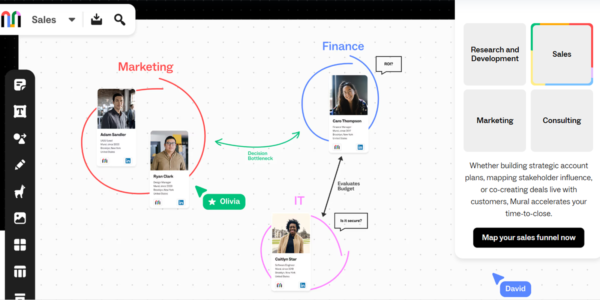
Mural calls itself an infinite canvas. I would call it something else: a room that never forgets. Walk into it, and you find the residue of every mind that has passed through — a sticky note here, a half-formed idea there, a stakeholder map someone drew at 2 a.m. before a big pitch. Nothing evaporates. Nothing waits in someone’s inbox to be rediscovered six months later. The room simply captures what the team once knew, so the team never has to search for it twice.
There is a phrase Mural uses that I keep returning to: “Seeing is how.” How a scattered group becomes a single mind, how six people in six time zones stop talking past each other and start building something none of them could have built alone. This is the quiet promise behind co-creation. It is not a meeting technique. It is a way of letting the intelligence in the room — all of it, not just the loudest voice — become visible, shared, and usable.
The numbers back the value of Mural. SAP found a 50 percent lift in sales onboarding efficiency once new hires could see, rather than be told, how deals get built. IBM gave its sales teams a day and a half back every week — time that used to vanish into the cracks between six different documents. Hewlett Packard Enterprise reclaimed 800 hours of meeting time in a single year, simply by making sure nobody had to sit through a meeting to relearn what the team already knew.
This is what I mean by a win-win. The customer feels understood without repeating themselves. The seller feels supported without reinventing the account from scratch. And the deal closes faster — because trust builds visibly, in real time, rather than being asserted after the fact in a slide deck nobody reads twice.
Then he showed me something that stuck with me. A customer once told his team: “I’ve met a dozen people from your organization, and I never had to re-explain myself.” Sit with that for a moment. In an era where AI promises to make everything faster, the deepest competitive advantage may simply be not making your customer repeat themselves.
That is what Mural has built — a shared visual workspace where growth plans, discovery notes, and stakeholder maps live in one place instead of scattered across Slack threads, Word docs, and slide decks nobody reopens. Bill calls the fragmented alternative what it is: great work, trapped in silos.
His view on AI is refreshingly unsentimental. He believes in it — he is, by his own admission, one of the heaviest AI users at his company. But he is equally clear that AI without human judgment simply helps people move faster in the wrong direction. Critical thinking, he told me, matters more now, not less.
I left our conversation convinced of something simple. The future of sales won’t be won by the company with the most AI. It will be won by the company whose teams speak one language that reflects the collective intelligence of the organization.
That’s how Mural accelerates revenues.

Gerhard Gschwandtner is the founder and CEO of Selling Power. He has interviewed Marc Benioff and hundreds of the world’s top sales leaders and authors over a career spanning more than four decades. Reach him at gg@sellingpower.com.
Get our Enewsletter
Get the latest sales leadership insight, strategies, and best practices delivered weekly to your inbox.
Sign up NOW →