Dreamforce Takeaways: How Visionary Leaders Are Rewriting the Rules of Business, AI, and Humanity
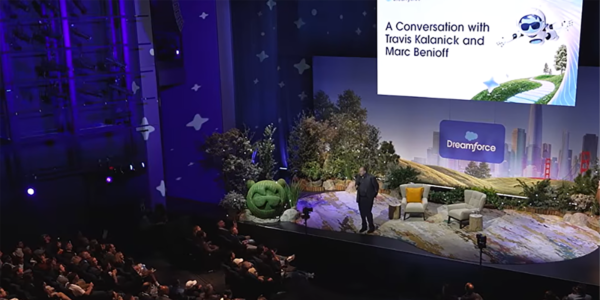
Three days, 1,433 sessions, at the Moscone Center. After the close, you are standing in an airport line trying to remember whether Matthew McConaughey or Marc Benioff said the line that stuck with you. It is signal overload. Hollywood’s Reese Witherspoon, new, AI enabled enterprise software and business tycoons like Altman, Huang, or H.E. Omar Sultan Al Olama all compete for the same finite attention, and the brain responds by blending everything into one glittering veneer that shines for days until it fades in the quiet reality of the flight home.
But once the Dreamforce sensory overload clears and the noise strips away, the essential truths of the AI revolution remain undeniable: the era of passive tools is dead, and the victors of the coming decade will be those who aggressively harness this unprecedented intelligence and boldly build their own agentic futures.
The Main Keynote

https://youtu.be/wYFt9NCYaVI?si=1Vy-pZUeCKj_i8eX
The keynote opened with McConaughey on screen, and the line that landed was pointed: the future is not the end of software, but the end of software that makes humans do all the work. Then Marc Benioff, Chair and CEO of Salesforce unveiled AIforce, a live interface layer sitting above Agentforce, Data 360, and Customer 360. He also introduced COA, Salesforce’s first CRM reasoning model, built on NVIDIA Nemotron.
Benioff’s vision: “The future isn’t about choosing one intelligence. It’s about having access to the best intelligence in the world. And choosing the right one for whatever you are trying to do.”
Claudeforce moved into open beta, and Sales Cloud in Claude was demonstrated live. Seven named agents rounded out the news: Casey, Paige, Carter, Marshall, Piper, and Fin are generally available, while Hunter is in pilot.
Benioff added: It’s not the end of software. It’s the end of software that makes humans do all the work.”
Demolishing the Passive Software Paradigm
For more than two decades, the corporate world settled for a strictly transactional relationship with its technology. Workers opened applications, navigated endless menus, and clicked through convoluted databases just to unearth the intelligence buried within their own corporate systems. That passive era is officially dead. The future belongs entirely to the “Agentic Enterprise,” a bold new paradigm where dynamic, context-aware AI agents anticipate business needs, autonomously execute complex workflows, and render bespoke user interfaces entirely on the fly.
Benioff underscored that this evolution does not signal the catastrophic end of the tech industry, but rather a profound liberation of the global workforce. However, this immense power requires an equal measure of accountability. Leaders can no longer hide behind their algorithms when things go wrong.
Benioff called for accountability, asking: “Are we not all responsible for our companies? Are we not all responsible for the products that we’re building?”
Manufacturing Intelligence at Global Scale

https://youtu.be/N2Zekittusw?si=nb1gSr7ewEs-U6RS
This agentic revolution is not running on thin air or theoretical promises. It is powered by unprecedented, physical advances in raw compute and a rapidly expanding global infrastructure. NVIDIA CEO Jensen Huang framed the current moment not merely as a software update, but as an entirely new industrial revolution. Data centers have transformed from simple storage warehouses into massive AI factories. These sprawling facilities consume raw data and electricity to manufacture the single most valuable resource on earth: intelligence.
Huang’s vision: “With electricity, we could power everything. With the internet, we can find anything. And now with artificial intelligence as an infrastructure layer across the planet, we can know everything and do anything.”
The sheer accessibility of this compute power means that no industry is safe from rapid disruption. We are moving toward a dual reality where enterprises will leverage massive, closed frontier models while simultaneously fine-tuning their own highly customized models to protect proprietary workflows.
“Every single software company is an AI company. And every single enterprise is going to be an agentic and AI enterprise.” — Jensen Huang
The Terrifying and Thrilling Velocity of Scaling Laws

https://youtube.com/shorts/FwPFgJsDODc?si=b4ad4A1j0VSU2LxF
Despite the staggering speed of this hardware and software evolution, humanity is barely scratching the surface of its potential utility. Anthropic CEO Dario Amodei pointed out that the scaling laws initially formulated by his team continue to hold absolute truth; injecting more compute into these models consistently yields exponentially smarter, more capable systems.
The sheer pace of this cognitive evolution is breathtaking. The true bottleneck is no longer the underlying technology itself, but the rate at which businesses and individuals integrate this profound intelligence into their daily operations to drive tangible value.
Amodei’s vision: “I formulated the scaling laws along with some of my co-founders which tell you that AI models get smarter and smarter the more compute you throw into them… But I think what we didn’t appreciate is that it would lead to these companies growing so fast… and how quickly they would become central to everything that’s going on in the world.”
Empowering the Human Creator

https://youtu.be/Bh5bJrrJ6xs?si=z5vjjGuwn2v-egsd
This leap from passive digital tools to proactive digital coworkers represents a fundamental upgrade in human potential. OpenAI CEO Sam Altman noted that the technological milestones humanity previously relegated strictly to the realm of science fiction are now everyday realities.
Altman remains fiercely optimistic about the ultimate human impact. The primary objective of the next decade is not merely advancing the machine for the sake of science but deploying these capabilities to radically elevate what individuals can accomplish. The ultimate success of AI will be measured by its ability to empower a single-person company to achieve the output of a massive corporation.
Altman’s Vision: “The sci-fi movies I think came true. You’re talking to your personal super assistant and you are working 10 times faster or better or more creatively than you could have before. I think this will transform the way we work, the way we kind of use computers, and it feels all of a sudden here.”
Unleashing AI in the Physical World

https://youtu.be/Ho1gnEeVryA?si=SomK-sQF1IIE9Dee
While digital intelligence scales rapidly through code, applying these breakthroughs to the physical world—where gravity, physics, and human safety dictate the absolute rules—requires an entirely different level of operational rigor. Siemens CEO Roland Busch reinforced the high stakes of applying AI to heavy industry. When AI commands an automated factory floor, steers a high-speed train, or analyzes a healthcare CT scan, software hallucination is not a mere glitch—it is a catastrophic failure.
Industrial AI must remain strictly deterministic, tethered directly to physics-based simulations, structured data ontologies, and rigorous safety standards. Busch emphasized that workers must unlearn outdated methodologies and rapidly embrace AI as a core competency rather than fearing it as a job replacement.
“The genie is out of the bottle. I mean, AI will change the world in the next years, as sure as we are sitting here, so you better embrace it.” — Roland Busch
Building the Atoms-Based Computer

https://youtu.be/JwGq6jIYdeQ?si=Eh8aTYgjREyVLJP-
We are witnessing the birth of “atoms-based computers,” where manufacturing lines, real estate, and logistics networks become fully programmable entities. Travis Kalanick co-founder and former CEO of Uber and now CEO of Atoms/CloudKitchens, highlighted this brutal but necessary transition from consumer software to heavy, physical industry. Just as the digital world relies on CPUs to manipulate bits, storage to hold them, and networks to move them, the physical world requires an analogous infrastructure.
Winning in this incredibly difficult B2B space requires uncovering deeply buried insights that competitors overlook, fueling a new age of industrial dominance built entirely on physical automation.
“Valuable unknown truths, things that are true that nobody else knows. If you get good at that, you know things other people don’t know. If you know things other people don’t know, you can do things other people can’t do.” — Travis Kalanick
Charting the Human Course Through Audacious Action

https://youtu.be/uDr29kCjVFI?si=FuXiJ5Ngqxoir5oq
Technology alone dictates nothing; the actual trajectory of this revolution rests entirely on the culture we cultivate, the authentic stories we amplify, and the bold actions we take. As AI effectively strips away repetitive, mundane tasks, the ultimate premium on authentic human connection, bold leadership, and creative conviction skyrockets.
Reese Witherspoon, founder of Hello Sunshine, demonstrated the sheer power of identifying a massive societal gap and leveraging unyielding grit to fill it. Faced with a Hollywood studio ecosystem that explicitly refused to develop female-led narratives, she bypassed the entrenched gatekeepers, self-funded her own vision, and built an empire. Her journey serves as a masterclass in modern entrepreneurship: leaders must fiercely reject the status quo and place massive, unapologetic bets on their own capabilities.
“I realized in that moment I could either get busy being amazed by this problem. Or I could do something about it.” — Reese Witherspoon
Bridging the Chasm Between Innovation and Regulation

https://youtu.be/NzB-zZFTfrA?si=Wq-5paspcMA-f4d9
This imperative to take decisive, visionary action extends powerfully to the global geopolitical stage. H.E. Omar Sultan Al Olama, the UAE’s Minister of Artificial Intelligence, drew a sharp, undeniable historical parallel to the invention of the Gutenberg printing press. The Middle East’s fear-driven ban on the printing press—rooted in anxieties over misinformation and loss of control—resulted in centuries of devastating technological stagnation.
Today, global governments simply cannot afford to let the fear of the unknown paralyze AI adoption. They must actively and aggressively deploy AI to improve citizen quality of life, exactly as the UAE has done by training 80,000 federal employees on agentic AI. The path forward requires radical collaboration, bringing actual technologists into the halls of government to draft agile, effective laws that protect citizens without suffocating progress.
“The innovator wants to break the rules to create something that doesn’t exist, that in his or her opinion is going to change the world. The regulator’s dilemma is, I need to safeguard against them breaking something that’s going to hurt people.” — H.E. Omar Sultan Al Olama
We are no longer waiting for the distant future to arrive. The advanced tools required to fundamentally rewrite entire industries are fully operational and sitting right in front of us. The victors of the coming decade will be those who aggressively filter the noise, reject the blur, and harness this unprecedented intelligence to amplify their own courage, creativity, and unyielding ambition.

Gerhard Gschwandtner is the founder and CEO of Selling Power. He has interviewed Marc Benioff and hundreds of the world’s top sales leaders and authors over a career spanning more than four decades. Reach him at gg@sellingpower.com.
Get our Enewsletter
Get the latest sales leadership insight, strategies, and best practices delivered weekly to your inbox.
Sign up NOW →