Dialing for Losing Sales
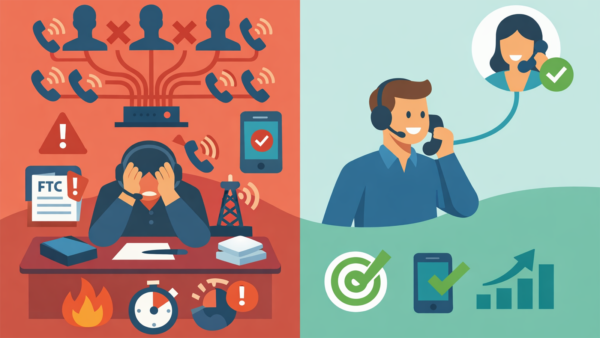
If you have answered your phone lately only to hear silence, a click, or an immediate hang-up, you probably aren’t imagining things. Those dead-air calls are exploding. And they are not just coming from overseas scammers. Many are being generated by U.S. sales teams using dialing technology that treats your phone number like a lottery ticket.
A growing number of these calls come from parallel dialers – systems that dial five, eight, sometimes 10 people simultaneously, betting that a rep will be available when someone picks up. When no one is free, the call drops. You hear nothing. Your number gets logged. The carrier takes note. Everyone loses.
This is not just annoying. In many cases, it is illegal.
The Math That Created the Problem
For years, outbound sales culture has rewarded activity over outcomes. More dials. More attempts. More at-bats. Parallel dialers became popular because they promised to brute-force a structural problem: Only about 20% of any B2B prospect list will ever answer a cold call. That is not a technology problem. It is a human behavior reality. Most people simply do not pick up numbers they do not recognize.
Rather than solve that problem, parallel dialers tried to outrun it. The pitch was seductive. Dial 10 lines at once and you multiply your odds. On paper, it looks efficient. In practice, it creates a cascade of consequences that most sales leaders do not see until the damage is done.
The Compliance Risk No One Budgets For
Here is what happens when a parallel dialer connects to a prospect and no rep is available: The call drops. That is an abandoned call. Under the Telephone Consumer Protection Act, the FTC holds that abandoned call rates above 3% constitute an abusive calling practice. Parallel dialers, by design, create abandonment at rates that routinely exceed that threshold.
Carriers see the pattern too. Repeated short-duration calls from the same number cluster trigger spam-likelihood algorithms. Once flagged, your entire calling infrastructure is compromised. Not just for the prospects you are blasting, but for the ones who were actually willing to talk.
Sales leaders consistently underestimate this exposure. Excessive abandoned calls can trigger fines, class action lawsuits, and carrier-level blocking. Regulators do not care that your board wanted 40% pipeline growth or that headcount was frozen. If your technology is generating dropped calls at scale, then the liability sits with you.
And the problem is about to get worse. Apple’s upcoming iOS call screening features will use on-device AI to evaluate incoming calls in real time. If your reps cannot immediately speak when someone answers – because three other lines picked up first – then that call gets screened, flagged, or silenced before the prospect even sees it. Parallel dialers are building their architecture on a foundation that the carriers and device manufacturers are actively dismantling.
The Burnout Loop
Compliance risk is the headline. Burnout is the quieter killer.
As numbers get flagged and connect rates erode, leadership responds predictably: more activity. The rep who was making 80 dials a day gets told to make 120. Conversations become rushed. Prospects hear an awkward pause – the telltale two-second delay while the dialer routes an answered call to an available rep – and hang up. The few conversations that do happen feel adversarial because the rep has been grinding through silence for hours.
One SDR manager described the dynamic bluntly: You roll out the parallel dialer, you get a quick pop in connect rates, and then it deteriorates month over month until you are left with something you do not even want to use anymore. Teams that adopted parallel dialers to compensate for 3% connect rates often find themselves at 1.5% within six months, with a burned-out team and a contaminated number reputation to show for it.
This is the tradeoff sales leaders do not want to admit. The tool they bought to solve low connect rates is actively making them worse.
What the Shift Actually Looks Like
Outbound sales was never meant to feel like harassment. It was meant to create conversations.
That is why the next generation of outbound technology is moving away from dialing more lines and toward identifying the right ones. The emerging approach – behavioral intent scoring – uses telecom-level signals, carrier data, and AI-driven pattern analysis to determine which prospects in a given list are likely to actually answer the phone. Not based on job title. Not based on time of day. Based on observable phone behavior patterns.
The operational difference is fundamental. Instead of one rep racing across 10 simultaneous lines, hoping someone picks up, you match one prepared rep to one high-probability call. No dead air. No abandoned calls. No two-second delay. No behavior that triggers spam labeling or compliance exposure.
Sales teams running this model report reaching three to five times more decision-makers per rep, with connect rates above 20% sustained over months – not a quick pop followed by decay. Reps make fewer total dials but have dramatically more conversations. Ramping reps hit flow state faster because they are actually talking to people, not listening to dial tones for eight hours. The downstream effects compound: cleaner pipeline data, faster messaging iteration, shorter ramp times, and materially lower cost per meeting.
The Question That Matters Now
Outbound is getting harder. Attention is scarcer. Regulation is tighter. Carriers are more aggressive. Device-level call screening is coming for every smartphone on the market. The margin for error in how you reach prospects is shrinking by the quarter.
The question sales leaders need to answer is not whether their team is dialing enough. It is whether their technology is earning conversations or manufacturing the conditions that prevent them.
Because every dropped call damages brand trust. Every spam flag makes future growth harder. Every shortcut taken today compounds into a higher cost tomorrow.
The spam call problem is not just a consumer issue. It is a sales leadership issue. And the companies that solve for precision over volume will be the ones whose calls still get answered.
Joey Gilkey is the CEO of TitanX.
Get our Enewsletter
Get the latest sales leadership insight, strategies, and best practices delivered weekly to your inbox.
Sign up NOW →