Selling in a “53% Bad” World: The Trust Deficit That’s Reshaping Sales
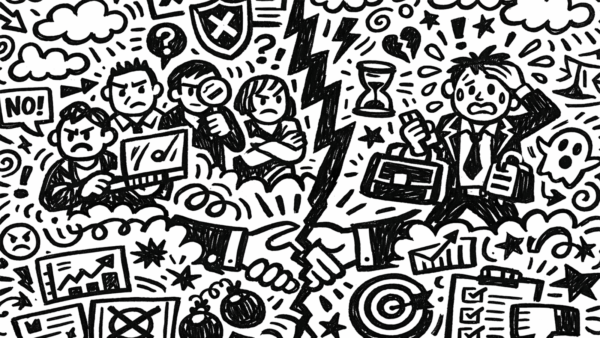
A new Pew Research study landed last week and it stopped me cold. In a survey spanning 25 countries, the United States was the only nation where more adults rated their fellow citizens’ morality as bad (53%) rather than good (47%).
Every other country – including Canada, where 92% see their compatriots as morally upstanding – went the other direction.
Let that number sit for a moment. The majority of Americans look at the person next to them in line at the grocery store, in the meeting room, or on the Zoom call, and their default assumption about that person is that they’re morally objectionable.
As Pew’s own senior researcher noted, however, this is the first time this question has ever been asked – so we don’t yet know if this is a long-standing American trait or something newly metastasized. Either way, the implications for anyone who sells for a living are profound and personal. Cynicism doesn’t stay at home; it walks with the buyer straight into your pitch.
The Mirror of Distrust: What the Data Looks Like on the Front Lines
I’ve spent over 40 years studying the psychology of selling. What Pew is measuring at the societal level, we’ve been watching play out in the buyer-seller relationship for years. The survey doesn’t describe something abstract; it describes your Monday morning.
The Buyer Who Arrives Armed
Gartner’s 2025 B2B Buyer Survey found that 61% of B2B buyers now prefer a rep-free buying experience. Read that again: Six in ten buyers would rather never speak to a salesperson at all. And 73% actively avoid vendors whose outreach they find irrelevant – which, in a culture primed for suspicion, is most outreach.
This isn’t laziness or self-sufficiency; it’s self-defense. When the base assumption is moral bad faith, a salesperson isn’t perceived as a guide or consultant. They’re perceived as a motivated actor with something to gain at the buyer’s expense. Buyers come pre-loaded with research, objections, and a near-impossible standard for the first impression.
Gartner’s Robert Blaisdell put it bluntly: “Bad prospecting actively damages relationships with potential customers.” His colleague Alice Walmesley added the flip side: Sellers who want to survive this climate must stop reciting information buyers can find on Google and start acting as a “sounding board” – a thinking partner with unique contextual intelligence.
The Salesperson in a Defensive Crouch
Here’s the uncomfortable truth: Salespeople are citizens too. They live inside the same 53% statistic. They bring the same ambient distrust to the relationship. The result is what I call the “double-sided trust crisis”: The buyer expects to be manipulated and the seller expects to be ghosted. Both arrive braced for the worst. The deal hasn’t even started and the relationship is already in debt.
This explains something I’ve observed in sales cultures over the past several years: a creeping shift from building rapport to hitting metrics. When you expect rejection, you optimize for volume. When you expect trust, you invest in depth. Right now, too many salespeople are playing a numbers game in a relationship sport.
The Canada Effect: What High-Trust Sales Cultures Look Like
When 92% of Canadians see their fellow citizens as morally good, social capital does the heavy lifting in commerce. Trust is a default, not a destination. Sales cycles move faster. Due diligence is lighter. The buyer comes in warm.
In the U.S., we pay what I’d call a “cynicism tax” – the extra time, legal reviews, reference calls, proof-of-concept hoops, and approval layers required to overcome a baseline assumption of bad faith. This isn’t bureaucracy for its own sake; it’s the institutional infrastructure that low-trust societies build to transact safely. And it is expensive not only in time but in energy and in margins.
The Data Keeps Arriving, and It’s All Saying the Same Thing
The Pew findings don’t exist in isolation. Consider the corroborating evidence: The 2026 Edelman Trust Barometer identifies what CEO Richard Edelman calls a “Crisis of Insularity.” His team surveyed 33,938 people across 28 nations and found that 70% are now hesitant or unwilling to trust anyone with different values, backgrounds, or information sources. Edelman describes the trajectory: from polarization to grievance to insularity. “All of these things are like dominoes,” he said. “It’s a cumulative weight.” That weight lands in your sales meeting.
Gallup’s 2026 Honesty and Ethics Survey found that car salespeople (7%) and telemarketers (5%) remain at the absolute bottom of professional trust ratings – essentially tied with members of Congress. Decades of data, year after year, the same result. The profession hasn’t done enough to change the story. That’s a leadership failure, not a perception problem.
PwC’s Trust in US Business Survey documents a gap that borders on delusion: 90% of executives believe their customers highly trust them, but only 30% of consumers actually do. That’s a 60-point chasm between self-perception and reality – and it widened from 57 points the year before. Leaders are operating on a trust budget they don’t actually have.
Breaking the Cycle: The Radical Act of Selling with Trust
In a “53% Bad” world, the burden of proof has shifted entirely to the seller. You don’t get the benefit of the doubt anymore; you have to earn it from the first sentence, and then again from the first follow-up, and then again when something goes wrong.
This means the most powerful thing a salesperson can do today is not a better pitch – it’s radical transparency. Stop trying to close before you’ve opened. Validate the buyer’s research instead of displacing it. Admit what your product doesn’t do. Say the things your competitor won’t say about themselves.
In a climate defined by negativity bias, the most valuable currency isn’t your product feature set. It’s the rare, almost shocking experience of being treated like an intelligent adult by someone who has nothing to hide. That’s the competitive advantage that no competitor can copy – because it requires character, not technology. The data is clear. The question is whether you can elevate your buyer relationship above the prevailing cultural norms.
Gerhard Gschwandtner is founder and CEO of Selling Power.
Get our Enewsletter
Get the latest sales leadership insight, strategies, and best practices delivered weekly to your inbox.
Sign up NOW →