The Visionaries Who Built the Modern Sales Machine
Before the cloud, before the smartphone, before “CRM” was even a term, there was chaos. Salespeople were drowning in a sea of business cards, sticky notes, and paper Rolodexes. Following up was a guessing game, and managing relationships at scale was nearly impossible.
I’ve spent my career studying what separates the best from the rest, and it always comes down to process and relationships. In the 1980s, three pioneers saw this truth and built the tools that would change selling forever.
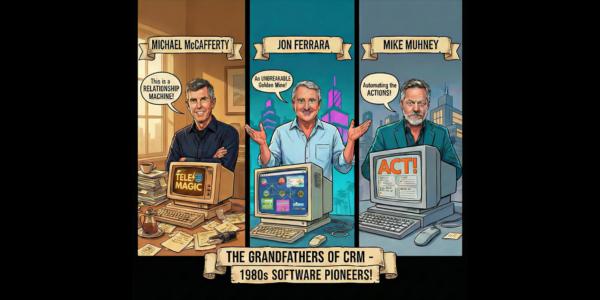
These weren’t Silicon Valley tech gurus; they were salespeople who built solutions to solve their own problems. Michael McCafferty, the “Father of CRM,” used his experience at IBM to create TeleMagic in 1985. He understood that software was useless if salespeople wouldn’t use it. As Selling Power noted, his philosophy was to build a program for salespeople, not for programmers. McCafferty’s vision was grounded in practicality and relentless improvement. His motto says it all: “Focus. Work smart. Work hard. Do good. Get lucky. That’s my story.”
Just two years later, Mike Muhney and his partner Pat Sullivan launched ACT!, a system born from their own frustrations as salespeople. Muhney, often called the “Godfather of CRM,” knew that technology was just a means to a deeper end. He saw that the real currency of business wasn’t just data, but the human connection that data could empower. His vision was clear and remains profoundly relevant today: “Successful business comes from meaningful relationships!”
Then came Jon Ferrara, who co-founded GoldMine in 1989 with just $5,000. Ferrara’s genius was in seeing beyond the individual salesperson. He envisioned a platform that would unite the entire company around the customer. His goal wasn’t just to manage contacts, but to orchestrate the entire customer journey across all departments. He said it best himself: “I wanted a relationship manager that enable[d] the whole team to participate in the entire journey of the customer.”
These three men didn’t just invent a software category; they digitized the art of relationship-building. They understood that technology should augment our humanity, not replace it. They laid the foundation for the entire multi-billion-dollar CRM industry by focusing on a simple, timeless principle: Relationships are the engine of sales. Their legacy is a powerful reminder that the greatest innovations are born from a deep understanding of the human element in every transaction.
What’s most remarkable is the staying power of these foundational ideas. Decades later, platforms like ACT! are still actively used, a testament to a simple truth: When salespeople find a process that works, they are famously resistant to change. This loyalty stands in stark contrast to the chaotic churn of the modern sales tech landscape. The sales and marketing technology space alone has exploded to over 15,000 solutions, with more than 1,200 disappearing in a single year through acquisition or failure. While countless tools have come and gone, the core concepts of these pioneering systems have endured. It proves that some ideas, when grounded in solving a fundamental human challenge, have a much longer lifetime than the fleeting trends that follow.
Gerhard Gschwandtner is the Founder and CEO of Selling Power.
Get our Enewsletter
Get the latest sales leadership insight, strategies, and best practices delivered weekly to your inbox.
Sign up NOW →